I came across the blogpost Why a Career in Computer Programming Sucks recently, which argues that programming makes for a terrible long-term career choice because the languages and technologies are always changing:
Computer programming is a job that’s heavily dependent on temporary knowledge capital. It’s temporary because the powers that be keep changing the languages and tools that programmers need to do their jobs. In nearly all other professions, knowledge capital increases as you grow older because you keep learning more about your field. But in computer programming, the old knowledge becomes completely obsolete and useless. No one cares if you know how to program in COBOL for example. It’s completely useless knowledge.
The technologies are all new and different every five years; therefore, anything you learn today will be “completely useless” before you know it. It sounds like common sense, but is this really the case?
My experience is that it is not. Fresh out of college I learned Hypertext Markup Language (HTML), the basic script that tells your browser how a web page should look. Then I learned JavaScript, code to make my HTML pages more dynamic. Then I learned Edify, a visual interface tool that allowed me to draw programs in flowcharts (Wish I had a screenshot of the interface. People always thought I was playing videogames when I was programming). I was able to port this foundation in programming to a job writing Active Server Pages (ASP), using VBScript. With a familiarization of data arrays, I Worked my way into database development and SQL scripting.
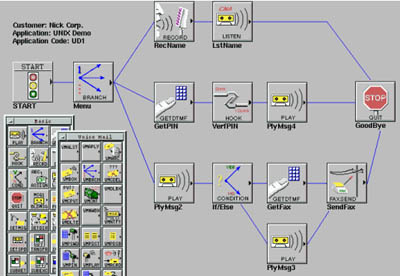 OmniVox telephony application (A Close Approximation to What Edify Looked Like) |
What kicked off this 10-year journey of exploration? Running a BBS on my Commodore 128 as a kid.
I work with people who have decades of programming experience, who spent years writing COBOL on mainframes. Far from obsolete, these developers come up with some of the most ingenious programming solutions I’ve ever seen in modern technologies. That’s because some of them have 40 years experience in programming, and can tell you why the system works the way it does.
In 10 years of working as an IT professional, I’ve learned that if you know ASP, you know PHP. If you know SQL Server, then you know Oracle. If you can make the website work in one web browser, you can make it work in all of them.
The reason programmers only get better with age is because, while the syntax for the latest programming language might be new, the logic and methodologies underlying it is the same. If/Then’s, arrays, loops, and the principles of good programming don’t change; they become more refined with time.
Good programmers refine themselves with them.
Note: Most employers don’t see it this way. Many will go with the 22-year-old developer over the one with 20 years experience because employers look for experience in specific technologies, failing to understand the common principles underlying them all.
Most employers are dumbasses, but you all ready knew that.
Comments
5 responses to “Computer Programming as a Longterm Career”