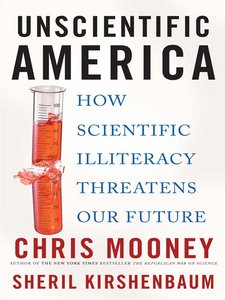
 Unscientific America |
Chris Mooney and Sheril Kirshenbaum’s Unscientific America: How Scientific Illiteracy Threatens our Future is a worthwhile survey of the cultural, academic, entertainment, and political aspects of science in America, and how they all contribute to the steady decline of science primacy in our country. Mooney and Kirshenbaum’s writing benefits from their immersion in the Science Blogging culture, where they are on the frontlines of the debate about how to best communicate science and bring it into the public eye (Note: Because I’m already tired of writing the names “Mooney and Kirshenbaum,” I will heretofore refer to them as “the authors” or “Moonenbaum.”). Moonenbaum does well in expanding the scope of their book to include, not just the division between the scientifically literate and illiterate, but the divide between experts in specialized fields of science, and the differences of opinion between scientists concerning what is acceptable science coverage in the media.
For instance, the author’s mention Larry Moran of The Sandwalk blog, who I have mocked in the past with a great deal of emotional immaturity and who argues that it is fine for science journalism to die because he thinks it error-ridden and worthless. At the 2007 Science Blogging Conference I saw him take some representatives of the Science News Hour to task for not knowing the journal sources backing up the stories they were covering. Dr. Moran is pedantic and elitist, which is fine for a professor, who must guard the gates of his academic profession to make sure only those who will contribute to its integrity get in. There is a place for his writing, which takes the media to task for calling a fossil a “missing link” when the term is silly, for running a sensationalist article title that misrepresents the science content, and that science media outlets and even journals all pretty much FAIL.
Of course, if we got rid of all these aspects of popular science journalism, there would be no need for science sections in newspapers, documentary channels on cable tv, or ideonexuses (ideonexi?) on the Internet. This site thrives on “Gee Whiz” 30-seconds-or-less science news. I get enough hardcore science at work, and I want foo-foo science when I get home. Carl Sagan, Moonenbaum aptly notes, was the greatest foo-foo science popularizer of them all (I think their term was “Science Ambassador” or “Proponent”), and he was skewered by the scientific community for bringing science to the everyday person:
…Sagan was punished by the scientific community for his public endeavors… Harvard University denied him tenure. Nobel laureate Harold Urey, a chemist who had previously served as one of Sagan’s mentors, helped quash his chances with a nasty letter objecting to Sagan’s budding media and outreach efforts.
This is so tragic considering Sagan delivered that unique sense of wonder to the masses that comes from understanding the world a little better. Even if some of the details are out of context, we’re still benefiting from it. So I’m with Sagan and Moonenbaum in that I don’t want science news to die. I want people tuning into science programs all day long, science radio while they work, I want them talking science at the coffee shops like they did during the Enlightenment. I don’t care if they’re getting the details wrong or are talking about some discovery out of context or over-emphasizing the significance of a finding that really isn’t a big deal. I want people rejoicing in science daily, appreciating it the way they appreciate reality television shows or summer blockbusters.
So when Moonenbaum takes on science in Hollywood films, I was surprised to find myself falling on the side of being a little more lenient in my appraisals. For instance, the authors take the film The Core to task for its admittedly ridiculous premise, but ignore the fact that all of the film’s heroes were scientists, and that the film’s climax involved a physics solution scientists should appreciate. John Rogers, one of the six screenwriters on the film, explained his intent:
When I came on, I set out to make one of the 50’s/60’s “science hero” movies that inspired me to go into physics (it was those movies and Lucifer’s Hammer actually, that led me to my field). I probably should have told Paramount that’s what I was up to, but it’s more likely for the best they had no idea what I was up tp. The Core is an explicit rejection of the “scientists bad, blue collar/soldier boys good” ethos that seems to have taken over current cinematic science fiction… If one kid sees physicists saving the day with wave-interference formulas fer chrissake, as in our big finale, and thinks it’s cool, we did okay. [sic]
No matter what you think of The Core as a film, it did kick off an epic debate between David Brin and John Rogers about communicating science in film and the originality of ideas in Hollywood. Just like even though it misrepresented black holes, blood boiling in a vacuum, and the destructive force of supernovas, the new Star Trek was still a movie that made scientists the heroes. I got a near-sexual chill down my spine from the scene where Kirk tells Captain Pike, “I read your thesis.” Anything that provokes discussion about science is a good thing in my book.
I challenge any scientist to write an even halfway decent Science Fiction story with rock-solid science. I don’t care if the author spends an dissertation-length exposition on astrobiology explaining the metabolism of silicon-based extraterrestrials, I guarantee you a physics scientist is going to write a blog post making fun of the alien’s mode of space travel. This is exactly the reason why author Jo Walton quickly abandoned her attempts to write science fiction, because building a plausible SF world involves too much research and too much explaining details within details. Screw it, was her conclusion, it’s easier to write fantasy. That’s a writer scared off to the dark side by scientists the same way my gaggle of Dungeons and Dragons geeks will scared away the girls.
The point is that science fiction movies, even bad science fiction movies, provide teachable moments, a way to ride a little bit of science education onto a blockbuster movie’s coat tails. Moonenbaum points out how Phil Plait regularly does this on his Bad Astronomy blog (referenced in the above ST link), and he does it well, acknowledging that no science fiction story is going to get it all right and that storytelling trumps realism… until doing so violates the audience’s suspension of disbelief. Then they should be properly flamed, like 10,000 BC or Transformers: Revenge of the Fallen.
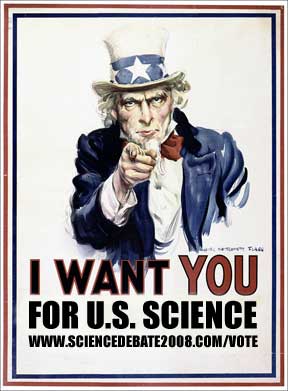 Science Debate 2008 |
The topic of flaming brings me to Moonenbaum’s research on science in politics, where they have much to be proud of through their involvement with Science Debate 2008, a movement that continues to be active (and a movement of which the Larry Moran’s of the world disapprove). They note how politicians are actually afraid to debate science because they don’t want to appear ignorant on the subject. Surveying the blogosphere’s opinions of politicians, how could they win? Even if they answered 90 percent of questions thoughtfully, they’d get burned for the one fact they got wrong.
But consider the alternative:
Representative Vernon Ehlers (R-MI), one of three physicists in Congress, describes having to rush to the floor to prevent fellow members from killing science programs they haven’t understood–assuming, for instance, that “game theory” research involves sports.
Scientists would rather abandon the control of public policy to this kind of ignorance rather than engage in public debate? If scientists represent the truth, what do they have to lose? As we can see in the author’s example, we have everything to lose by not debating.
Overall, Mooney and Kirshenbaum’s book is a fantastic survey of the many dimensions to consider when tackling the issue of waning interest in science for Americans. My concern for Unscientific America is that the book has a narrow audience. Non-scientists will pass it by, while scientists appear apathetic. I greatly appreciated the book despite much of it being old-news to me, and hope to see more books tackling the issue of bringing science back to the forefront of American imaginations once again.
Additional Thought
Comments
4 responses to “Mooney and Kirshenbaum’s “Unscientific America””