Arthur C. Clark’s book 2010 has an early scene that was left out of the movie. A Japanese spacecraft has raced to Jupiter’s moon Europa, ahead of a joint American-Russian expedition, to claim the satellite, and all its water, for Japan. Soon after the craft lands, Earth receives a radio transmission from a lone, doomed astronaut, stranded on the moon after something came up through the ice, attracted by the bright lights, to swallow the expedition’s ship.
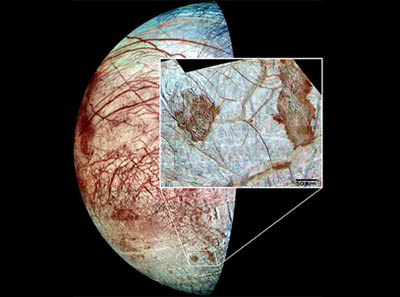 Europa’s Thrace Region (Evidence of an Ocean Beneath the Ice) Credit: NASA, Arizona State University |
The prolific SF author Alan Dean Foster’s Sentenced to Prism explores a planetary ecosystem of silicon-based life, as opposed to our carbon-based version. Dr. David Brin hypothesized plasma life hidden in our Sun in his book Sundiver, alien beyond understanding. Carl Sagan and Edwin E. Salpeter proposed in a 1976 paper, that an entire ecosystem of gas-inflated organisms could hypothetically exist, floating in Jupiter’s massive ocean of an atmosphere.
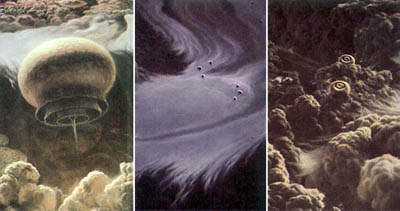 Life on Jupiter Credit: NASA |
If such speculation seems too implausible to take seriously, consider the many extremeophiles, life forms that thrive in harsh environments, here on Earth. Hyperthermophiles, like those giving Grand Prismatic Spring in Yellowstone Park, survive in 140 degrees C (284 degrees F) temperatures. Acidophiles live in pH of 2 – 3, such as phosphoric acid, which gives soft drinks their fizz and is strong enough to dissolve pennies. There are also bacteria fueled by radiation two miles below ground, taking up to a century to acquire enough energy to reproduce.
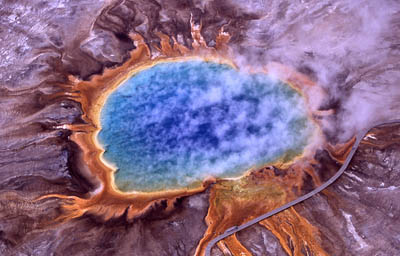 Grand prismatic spring, Yellowstone National Park Credit: National Park Service |

Recently, scientists have found an entire ecosystem of bacteria eating deep sea rock at fantastic pressures. Entire ecosystems, filled with large, complex animals surrounding sulfur vents also demonstrate that life need not be powered by the sun, as we are through Photosynthesis, but rather chemosynthesis, extracting energy directly from chemicals. Both of these are environments potentially mimic Europa’s oceans, which researchers are currently testing the Environmentally Non-Disturbing Under-ice Robotic Antarctic Explorer (ENDURANCE) probe to explore in the future.
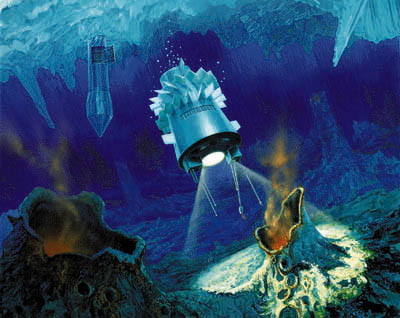 Cryobot Exploring Europa Credit: NASA |
In 1976, the Viking spacecraft landed on Mars, where it performed the Labeled Release experiment, stirring a radioactive broth into the Martian soil to detect emissions from any microbial life that may exist there. It found emissions indicative of life, but follow-up experiments were inconclusive, leading to a long-standing debate over what Viking discovered. In the 1990s a Martian meteorite found on Earth yielded fossilized hints of ancient bacterial life on Mars, but this finding also generates more controversy than consensus.
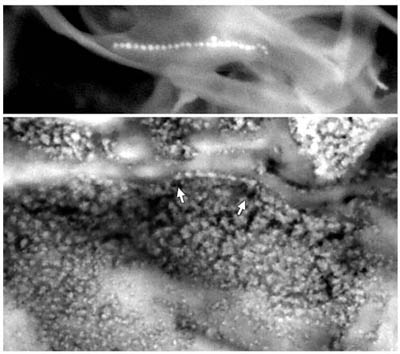 Top: Magnetobacteria on Earth Bottom: Possibly Fossilized Magnetobacteria from a Martian Meteorite Credit: NASA |
Astrobiologists hypothesize the myriad ways life unlike our own could exist and thrive on alien worlds. Organisms survive in environments of extreme heat and cold, acid and alkaline, and powered on energy sources solar, radioactive, and chemical here on Earth. For these reasons, the world pays close attention as the Phoenix Mars Lander gathers and analyzes Martian soil samples, seeking water, nutrients, and signs of life.
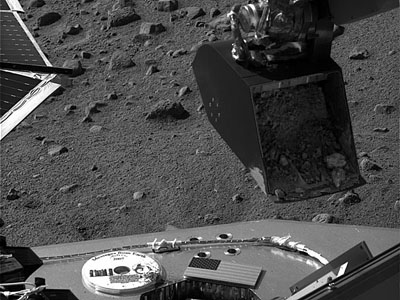 Is There Life in That Dirt? (From the Phoenix Mars Lander) Credit: NASA |
Comments
6 responses to “Life in Our Cosmic Backyard”