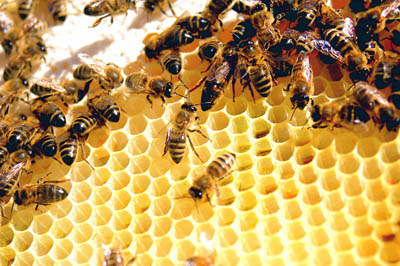
 Bees Forsake Their Own Reproduction for the Benefit of the Hive Photo by Todd Huffman |
Humans are funny animals. We cooperate at a level of sophistication seen nowhere else on planet Earth. Teachers, food servicers, law enforcement, medical workers, farmers, entertainers, engineers, truck drivers, and a bazillion other specialized laborers make our survival in its present convenience possible. The majority of us would die in a few weeks without our worldwide social support network.
Homo Sapiens behave altruistically toward one another. Human altruism is so strong that it even goes beyond our own gene pool. We are so nurturing that we adopt and care for members of other species like cats, dogs, houseplants, ant farms, hamsters, snakes, lizards, and other pets. We undergo Herculean efforts to save beached, stranded, or wounded whales.
Homo Sapiens care a lot.
We aren’t alone in this regard. In nature, we see cooperation and self-sacrifice everywhere. Primates like Chimpanzees and Gorillas work in cooperative altruistic fashion, as do pack animals. My two pet cats will often spend quality time grooming one another’s fur on the couch, taking turns licking those hard to reach places like on top of the head and chin. Another cat was documented mothering orphaned skunks. It’s obviously natural for members of a species to care for one another, and sometimes even outside their species.
Drone bees work tirelessly to feed their hives, even though they have no hope of reproducing themselves. Their queen, however, shares their genes, and if she survives to reproduce, the drone’s genes will survive as well. Lacking higher brain functions, the altruistic behavior in bees must be instinctual, carried within their DNA. The success of bees is living proof of the success of altruistic genes.
British evolutionary biologist W.D. Hamilton figured out that when an animal’s genetic relatedness to another (r) multiplied by how much altruism would benefit the recipient’s survival chances (B) was greater than the personal cost to survival of the altruistic animal (C), then the genes for altruism would propagate. Expressed mathematically as rB>C, it is known as “Hamilton’s Rule,” and some consider it the E=mc2 of biology.
 Hamilton’s Rule |
The science of Game Theory provides an example of altruism’s strength in numbers. In each round of a game called the “Prisoner’s Dilemma,” two players have the option to either act altruistically or betray the other player. If they cooperate, they both get three points. If they betray one another, they only get one point each. If one betrays and the other acts altruistically, the betrayer gets five points and the altruistic player gets zero.
Scientists have devised all sorts of strategies for winning this game, and those strategies put into algorithms and put into competition on computers. Of all the strategies put into this virtual world, the “Tit-for-Tat” (TFT) comes out on top. This strategy’s first action is altruistic and after that it simply does what the other player did on the previous round, rewarding altruism with altruism and betrayal with betrayal. When TFTs exist in the community, the other more altruistic strategies succeed with them, forming a cooperative community.
Between the success of TFT’s and mounting support for Hamilton’s Rule, we are finding that being good to one another not only makes moral sense, but logical and mathematical sense as well.
Dawkins, Richard, The Selfish Gene, Oxford University Press, 1976.
See also my previous post Nice Guys Finish First exploring the math behind the Prisoner’s Dilema in further detail.
Comments
4 responses to “The Mathematics of Cooperation”