“The best road maps to human bodies lie in the bodies of other animals.”
– Neil Shubin
 Your Inner Fish |
There’s a fascination to tearing apart an old house, tracing its history through what you find hidden behind the plaster. Electrical wires and pipes will run up to the attic and across, instead of taking a direct route through a wall, or worse, run up the outside of the house to enter a second-story bathroom. Awkward plaster intrusions will run between ceilings and walls, where air ducts were added after the house was built. Lead and asbestos hide under new layers of paint and insulation made from safer alternatives. Doors are shaved into rhombus shapes so they can fit into doorframes no longer rectangular from decades of shifting. Bad wall and floor joists are sistered up with new ones for seemingly redundant support. Other times, you just stare at the work of some carpenter long gone and ask yourself, “What on Earth were they thinking?”
The human body is like an old house. Our ancient ancestors started out with one design, a multi-celled organism, which morphed into animals with faces, which morphed into animals with legs and heads, which morphed into animals on two legs and big brains. The end result is a body that has nerves doing loop-de-loos through our body, running absurdly obtuse routes from our central nervous system to the areas of the body they service, holes pushed through muscles to make way for the male’s external sex organs, leaving a weak spot prone to hernias, and flexible throat muscles good for speech, but leave us prone to choking and sleep apnea.
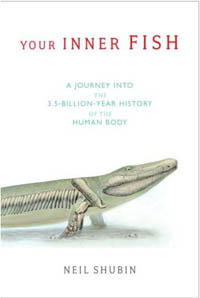
Neil Shubin’s Your Inner Fish is a comprehensive exploration of all our human evolutionary traits, and traces them to our ancient ancestors. I was a bit self-conscious reading this book in public. What would you think of someone intently reading a book titled “Your Inner Fish?” You’d wonder what psychiatrist recommended it, so you could avoid using them.
The book’s title is misleading in scope. This is not just a book about our inner fish, but our inner shark, inner worm, inner moth, sponge, single-celled organism. Haeckel’s Phylogeny Recapitulates Ontology may not be true, to the endless delight of Creationists, but understanding why it isn’t true opens the doors to understanding how different species can all start out looking the same as embryos and yet their organs develop into different specializations.
Several of my grade school teachers would explain the human appendix as once aiding in the digesting of raw meat, like cave people supposedly did. This was wrong wrong wrong wrong wrong wrong. Wrong on soooooo many levels. All my teachers had to do was look inside modern animals with functional appendixes to understand how wrong they were. That’s how we know our ancestors’ appendixes were for digesting cellulose found in plants. Comparative Anatomy is indispensable to understanding why our bodies work the way they do.
Shubin draws this fact out through recounting his adventures in fossil hunting, which sound so interesting that they made me want to go on finds myself. He describes fascinating experiments where biologists patch tissue from one animal embryo to another, producing growths that reveal the purpose of different genes, or scientists evolving algae from single-cell to multi-celluar life in the lab by introducing single-cell predators to their environment, or tying a hair around a newt embryo to cause it to grow into twins.
Shubin’s down-to-Earth, hand-on explorations make this book a gateway for laypeople to the biological sciences. The thrill of fossil-hunting, extracting DNA with common kitchen ingredients, or simply looking at the biology of other animals and appreciating how we relate to them make this book a keeper. It will change the way you look at everything in the Animal Kingdom.
Comments
8 responses to “Neil Shubin’s “Your Inner Fish””